
Case Number: JCL-2026-001
Subject Category: Entrepreneurship
Industry: Digital Media, Information Services, Market Research
Primary Source: Junction Podcast interview with Mohammad Ruhul Kader, recorded on June 27, 2026
Case Author: Shahlin Hossain, Junction Case Lab, Junction Bangladesh
Additional Data Sources: Generalized experience, company publications, public reports, website, and other relevant sources (where applicable)
Length: 6 pages
Published by: Junction Case Lab, Junction Bangladesh
Copyright © Junction Bangladesh. All rights reserved. This case is published by Junction Case Lab for educational purposes. Proper acknowledgement of the author(s) and Junction Case Lab, Junction Bangladesh, is required when citing or referencing this case.
Keywords: Entrepreneurship, Startup, Digital Transformation, Leadership, Decision Making
Introduction
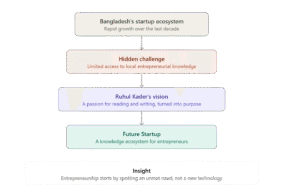
Bangladesh’s entrepreneurial ecosystem has grown rapidly over the last decade. Yet behind every successful startup lies another challenge that often goes unnoticed: access to knowledge. Entrepreneurs need stories, market insights, practical experiences, and local examples to make informed decisions. When Ruhul Kader founded Future Startup, he was not trying to build another digital news platform. Instead, he envisioned a knowledge ecosystem dedicated to documenting Bangladesh’s entrepreneurs, businesses, and innovations.
What began as a personal passion for reading and writing gradually evolved into one of Bangladesh’s leading entrepreneurship knowledge platforms. However, the journey was neither straightforward nor financially secure. It required years of persistence, experimentation, and continuous learning before becoming sustainable.
Entrepreneurship Insight
Entrepreneurship often begins with identifying an unmet need rather than inventing a new technology. Future Startup emerged by recognizing the absence of locally relevant entrepreneurial knowledge.
Chapter 1: Foundation and Discovery
Curiosity before Entrepreneurship
Long before becoming an entrepreneur, Ruhul Kader considered himself a learner. Growing up in Maheshkhali, Cox’s Bazar, he experienced firsthand the realities of limited opportunities, infrastructure constraints, and rural poverty. These experiences shaped his appreciation for education and knowledge as pathways to opportunity.
His passion for reading became the foundation of his entrepreneurial mindset. Influenced by authors such as Malcolm Gladwell and Seth Godin, he developed the habit of reading extensively, writing regularly, and questioning existing assumptions. Initially, he had no ambition to build a company. He simply wanted to write about entrepreneurship and business because those were the stories he wanted to read but could not find in Bangladesh.
Opportunity Mapping
While studying at Dhaka University, Ruhul noticed an important gap. Bangladesh had entrepreneurs, innovative businesses, and emerging technology companies, yet very few platforms documented their journeys in depth. Most available content focused on news rather than analysis or practical entrepreneurial learning.
Instead of asking,
“What business should I start?”
he asked a different question:
“What valuable knowledge is missing from Bangladesh’s entrepreneurial ecosystem?”
That question became the foundation of the Future Startup.
Teaching Highlight: Opportunity Mapping
Rather than identifying a product gap, Ruhul identified a knowledge gap. Opportunity mapping begins with observing unmet needs in the ecosystem rather than searching for ideas in isolation.

Chapter 2: Validation and Prototyping
Starting Small
Future Startup did not begin as a company. It began as a personal blog.
Without external funding or sophisticated technology, Ruhul experimented with publishing articles and interviewing entrepreneurs. Every interview, essay, and reader response became part of an informal validation process. Instead of developing an elaborate business plan, he allowed audience engagement to determine what content created value.
The positive response confirmed that founders, students, and professionals wanted thoughtful, long-form discussions about entrepreneurship.
Refining the Value Proposition
As readership grew, the platform’s identity became clearer.
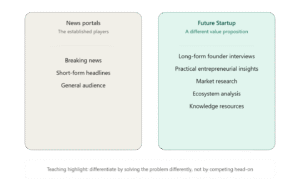
Future Startup was not competing with newspapers or online news portals. Its value proposition was different:
- Long-form founder interviews
- Practical entrepreneurial insights
- Market research
- Analysis of Bangladesh’s startup ecosystem
- Knowledge resources for entrepreneurs and operators
This clarity enabled the platform to occupy a unique niche.
Teaching Highlight: Value Proposition
Successful ventures often differentiate themselves by solving problems differently rather than competing directly with established players.
Chapter 3: Building under Constraints
Bootstrapping with Limited Resources
Like many first-generation entrepreneurs, Ruhul faced severe resource constraints.
He initially had no personal computer and often borrowed equipment from friends or used university facilities to write and publish articles. Rather than viewing these limitations as barriers, he adopted a lean operating model. Freelancers were hired only when projects generated revenue, allowing the organization to keep fixed costs exceptionally low.
This disciplined approach enabled Future Startup to survive over the years when many similar digital platforms disappeared.
Entrepreneurship Insight
Resource scarcity can encourage innovation. Bootstrapping requires entrepreneurs to maximize available resources before seeking external financing.
Chapter 4: Market and Financial Readiness
From Passion to Sustainability
Passion alone could not sustain the organization indefinitely.
One of the founder’s most significant realizations was that Future Startup needed a viable revenue model. The challenge was balancing commercial sustainability with editorial credibility.
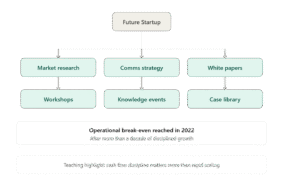
Over time, the organization diversified its activities:
- Research and market intelligence
- Narrative and communication strategy
- White papers
- Learning workshops
- Knowledge events
- Case library development
Each initiative built upon the platform’s reputation while generating additional revenue streams.
Financial Discipline
Instead of pursuing rapid expansion, the organization emphasized disciplined growth.
Expenses remained low; hiring was cautious, and every new initiative was expected to contribute value before being scaled. After more than a decade of gradual evolution, Future Startup reached operational break-even in 2022.
Teaching Highlight: Cash Flow
Revenue growth alone does not ensure survival. Cash flow management and cost discipline are often more important than rapid scaling, particularly in knowledge-intensive ventures.
Chapter 5: Communication, Mentoring, and Business Development
Building Trust through Stories
One of Future Startup’s defining capabilities was its ability to tell authentic entrepreneurial stories.
Its long-form interviews—often exceeding 8,000 words—became valuable resources for entrepreneurs, researchers, policymakers, and corporate leaders. These interviews also enhanced the organization’s credibility, leading larger companies to seek collaboration.
Rather than relying on aggressive marketing, Future Startup allowed quality content to build its reputation organically.
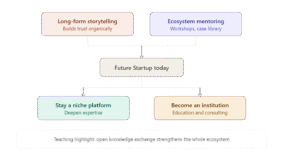
Mentoring an Ecosystem
Over time, the organization evolved from a publication into an ecosystem builder.
Through workshops, founder conversations, research publications, and the newly developed case library, Future Startup contributes to entrepreneurial learning in Bangladesh. Its mission extends beyond publishing content; it seeks to strengthen entrepreneurial capability by making practical knowledge more accessible.
Teaching Highlight: Networking and Mentoring
Entrepreneurial ecosystems grow when founders share experiences openly. Knowledge exchange can become a strategic resource that benefits individual entrepreneurs and the broader community.
Looking Ahead
Having achieved operational sustainability, Future Startup now faces a new strategic question.
Should it remain a specialized knowledge platform, or should it expand into education, consulting, digital learning, and international markets?
The answer will determine whether Future Startup remains a respected niche publication or evolves into a broader institution supporting entrepreneurship in Bangladesh.
Discussion Questions
- What entrepreneurial opportunity did Mohammad Ruhul Kader identify that others overlooked?
- Is Future Startup a necessity-driven venture or an opportunity-driven venture?
- Evaluate Mohammad Ruhul Kader’s entrepreneurial mindset.
- How did Future Startup validate its business idea?
- What is the value proposition of Future Startup?
- Identify the bootstrapping strategies used by the founder.
- What were the major challenges in monetizing Future Startup?
- How did credibility become a competitive advantage?
- Why did Future Startup survive while many similar media platforms disappeared?
- Evaluate Future Startup using the business model canvas.
- If you were the founder in 2025, what would be your next strategic move?
- What lessons can aspiring Bangladeshi entrepreneurs learn from this case?