
A well-designed strategy is pivotal, whether in personal and professional life, entrepreneurship, social challenges, community development, or even national growth. In a rapidly changing and complex environment, design thinking offers the capacity to address diverse internal and external factors through its iterative and human-centered approach. By engaging directly with lived experiences, it enables a deeper understanding of real and often complex human problems. Such understanding becomes the foundation for deriving viable and adaptable solutions, recognizing that problem-solving is an evolving process rather than a fixed destination.
In the modern era, Artificial Intelligence (AI) is increasingly integrated into individual lives and institutional systems globally, often positioned as a powerful tool for solving complex human challenges. However, AI-driven solutions may carry invisible limitations. Certain segments of the population, those living in remote regions, speaking indigenous languages, facing technological barriers, poverty, physical or cognitive challenges, as well as women and children, are frequently underrepresented in the data systems that feed AI models. This exclusion creates structural gaps. Addressing such gaps requires empathy and deep engagement with lived experiences, which lie at the core of design thinking. Unlike purely data-framed strategies, design thinking enables a more inclusive and holistic understanding of real human pain points and is better positioned to respond to unique, context-specific needs.
When it comes to the application of design thinking as a methodology, it was once largely associated with science especially in engineering. However, over the years, its iterative and problem-solving approach has demonstrated that it is not limited to any specific discipline. Rather, its holistic and human-centered framework makes it adaptable and effective across diverse fields.
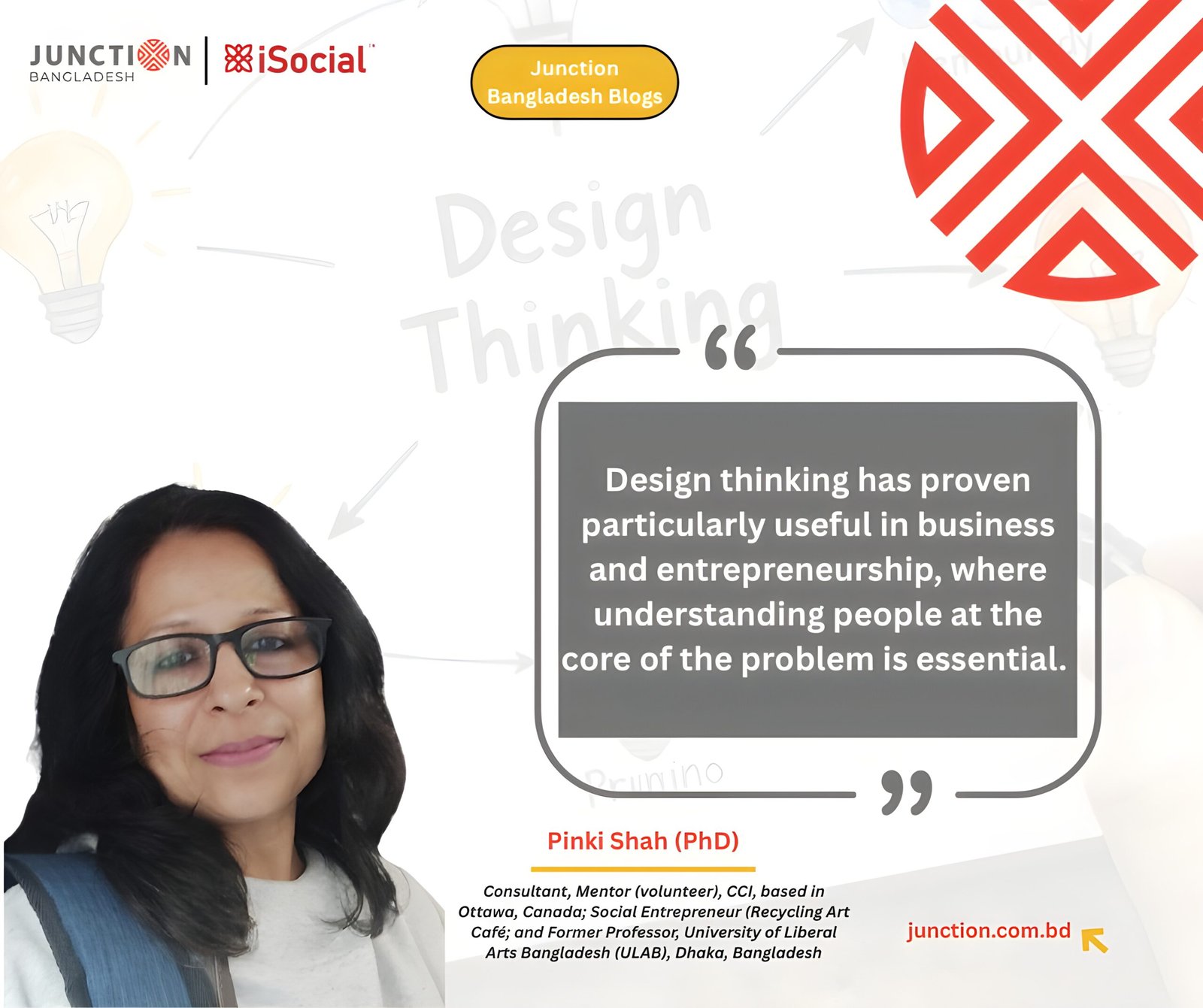
Design thinking has proven particularly useful in business and entrepreneurship, where understanding people at the core of the problem is essential. By identifying real pain points through empathy and engagement, businesses are better positioned to develop meaningful solutions. The strategy follows a nonlinear and iterative process, allowing continuous testing, feedback, and refinement of prototypes. This human-centric approach helps uncover the root causes of problems and gradually leads toward feasible and adaptable solutions with future scalability. Beyond entrepreneurship, design thinking can also shape strategies at individual, community, and national levels due to its flexibility and growth-oriented mindset.
The human-centered design thinking strategy has the capacity to assist in uncovering complex and sensitive challenging areas. For instance, in women’s health, social stigma, ignorance, and illiteracy often prevent young girls and women from openly discussing critical health and social issues. In such contexts, building trust and credibility becomes essential. Similarly, adolescents and youth may rely on unreliable sources for information, leading to misinformation and social detachment. Rural communities frequently face fundamental challenges related to water, hygiene, health, and access to safe energy, where external interventions often fail due to lack of community trust.
Observing these issues from the outside rarely exposes their depth, and solutions derived without local engagement often prove ineffective. The design thinking process enables a deeper exploration of such contexts through empathy, trust-building, and iterative feedback. By continuously engaging with the community in their local language and refining solutions, it becomes possible to address root causes more systematically and reduce the likelihood of policy failure.
When it comes to developing potential solutions after identifying a problem, it is often advisable to fail at an early stage. Early-stage experimentation reduces long-term costs and stress that may arise from hasty or poorly designed interventions. Rapid decision-making without adequate reflection or a growth mindset can result in rigid and ineffective outcomes. Traditional design approaches were often structured in a linear and fixed manner, leaving little room for iteration or feedback.
In contrast, design thinking emphasizes continuous refinement. Incorporating feedback throughout the process acknowledges that no solution is permanently final. This growth-oriented strategy promotes disciplined and sustainable thinking. By identifying core issues early and testing prototypes repeatedly, organizations can use resources more efficiently and avoid unnecessary waste. Over time, iterative testing leads to stronger, more adaptable solutions that are grounded in real-world feedback.
It is undeniable that we live in a complex and rapidly changing environment. Some changes arise from internal factors such as business policies, while others shoot from national fiscal, monetary, or trade decisions. Still few others emerge unpredictably from natural environment.
At the same time, human behavior has become increasingly complex. Information overload, digital connectivity, financial pressure, and future uncertainty influence how individuals think and make decisions. Many people hesitate to express their needs clearly, and in some cases, they are uncertain about what they are actually seeking. This makes it difficult for businesses,
community workers, system designers, and policymakers to accurately identify the challenges they aim to address.
Although numerous solutions and policies exist across geographies, they often seem insufficient and sometimes fail to respond adequately to modern human realities and their needs. Rapid technological change, shifting socio-cultural dynamics, demographic transitions, and governance structures all exert significant influence. In such an environment, a resilient and well-designed strategy becomes essential. That strategy must incorporate collaboration among diverse stakeholders or designers to create a holistic understanding of the issues at hand. This is where design thinking demonstrates its strength, by viewing human challenges from multiple perspectives and embracing a continuous, adaptive process toward meaningful solutions. In an age of complexity, strategy without empathy becomes fragile. Design thinking offers not certainty, but resilience.
Pinki Shah (PhD) is a Consultant, Mentor (volunteer), CCI, based in Ottawa, Canada. She is also a Social Entrepreneur, running Recycling Art Café and Former Professor, University of Liberal Arts Bangladesh (ULAB), Dhaka, Bangladesh. She can be contacted via pinkishah3@gmail.com.