
Subject Category: Entrepreneurship and Human Resource Management
Industry: Healthcare Assistance / International Patient Services
Primary Source: Junction Podcast interview with Farzana Wali Liza, Founding Chairman of International Medical Information Centre (IMIC), recorded on September 8, 2026
Additional Data Sources: Generalized experience, where applicable
Length: 8 pages
Published by: Junction Case Lab, Junction Bangladesh
Copyright © Junction Bangladesh. All rights reserved. This case is published by Junction Case Lab for educational purposes. Proper acknowledgement of Junction Case Lab, Junction Bangladesh, is required when citing or referencing this case.
Keywords: Entrepreneurship; Human Resource Management; Healthcare Entrepreneurship; International Patient Services; Patient-Centered Service; Healthcare Coordination; Employee Training & Development; Leadership; Business Growth; Diversification; Trust-Based Business; Bangladesh
From Healthcare Assistance to Trusted Patient Support
An HR and Entrepreneurship Case Study of International Medical Information Center (IMIC)
Case Overview
International Medical Information Center (IMIC) is a healthcare assistance center that supports Bangladeshi patients seeking treatment abroad. It works with international hospitals and assists patients who need overseas treatment, second opinions, critical-care coordination, emergency visas, and related medical travel support.
The organization was founded by an entrepreneur whose professional career began in the healthcare sector after completing a BBA. Her early experience was with the Bangladesh representative office of Singapore’s Mount Elizabeth Hospital, where she developed experience in healthcare and patient assistance.
The entrepreneurial opportunity emerged from observing a gap in access to information and international healthcare options. Rather than limiting patients to one premium hospital, the founder developed a network of hospitals across different countries and sought to match patients with options according to their medical requirements and financial capacity.
Today, IMIC’s work involves much more than arranging appointments or travel. Its activities include patient assessment and coordination, communication with doctors and hospitals, emergency visa processing, air ambulance coordination, and ongoing support for patients and their families.
The case provides an opportunity to examine how industry experience, networks, trust, employee capability, empathy, precision, and purpose can shape entrepreneurship in a highly sensitive service business.
Entering Entrepreneurship Through Industry Experience
The founder’s entrepreneurial journey did not begin immediately after graduation.
After completing a BBA, she wanted to work in the healthcare sector and began her career with the Bangladesh representative office of Singapore’s Mount Elizabeth Hospital. This gave her direct exposure to healthcare services and patient assistance.
After approximately six years of career experience, she had initially considered working for an MNC or embassy. However, her experience in the healthcare sector allowed her to recognize a problem faced by Bangladeshi patients seeking international treatment.
Premium international treatment was available, but patients also needed information, hospital choices, coordination, and assistance in navigating the process.
This became the foundation for IMIC.
Entrepreneurial Question
Can professional experience itself become an entrepreneurial resource?
The IMIC case suggests that industry experience can provide an entrepreneur with knowledge, networks, credibility, and a clearer understanding of customer problems.
Identifying the Market Gap
The founder recognized that patients seeking treatment abroad faced difficulties beyond simply identifying a hospital.
Patients needed help with:
- Understanding available international treatment options
- Comparing hospitals
- Matching medical needs with appropriate facilities
- Understanding financial implications
- Communicating with doctors
- Obtaining urgent visas
- Arranging emergency transportation
- Coordinating different parties across countries
Instead of working only with one hospital, IMIC developed relationships with hospitals in multiple countries. Patients are considered according to their medical requirements and financial ability before suitable options are identified.
This represents an example of problem-based entrepreneurship.
The business opportunity emerged from asking:
What difficulty is the customer experiencing, and how can we make the entire process easier?
A Patient-Centered Service Model
IMIC describes itself as a healthcare assistance center, rather than an agency. The organization emphasizes that it does not act as an agency or charge additional fees in the way described in the interview. Patients receive options based on their requirements and 24-hour support.
The organization’s role is also described as representing the patient rather than the hospital. Communication takes place among patients, hospitals, and doctors, while the organization coordinates the process.
This creates a distinctive service proposition:
Patient need → Assessment → Suitable medical option → Coordination → Ongoing support
The business is therefore not simply selling a transaction. It is managing a complex service journey.
The Importance of Networks
One of the biggest barriers to entering the sector is the need for strong networks.
The founder explains that people cannot effectively assist patients without experience and a properly developed network. Relationships with embassies are particularly important when urgent visas are required.
Building these relationships took considerable effort.
The network eventually extended across countries including Singapore, Malaysia, India, Thailand, Turkey, and Dubai, with further expansion being considered.
Entrepreneurship Lesson
For a service-based entrepreneur, the business’s most important assets may not always be physical.
They can include:
- Industry knowledge
- Professional relationships
- Institutional networks
- Trust
- Reputation
- Communication capability
- Experience
Empathy as a Business Capability
Healthcare assistance involves customers who may be experiencing some of the most stressful situations of their lives.
The founder describes empathy and emotional connection as important to IMIC’s work. Patients travelling abroad for treatment are going through an emotional journey, and the organization becomes part of that journey.
One of the strongest sources of motivation described by the founder is seeing patients return after receiving treatment—particularly patients who had travelled in extremely critical conditions and later returned to the office in much better circumstances.
This highlights an important HR question:
Can empathy be treated as an organizational capability?
In a healthcare-support business, employees need more than technical knowledge. They also need to interact sensitively with patients and families under pressure.
Building Trust Through People
Trust is fundamental to IMIC’s service.
The founder describes the team as experienced and having backgrounds similar to hers in healthcare. Employees communicate closely with patients and share relevant information with them.
Trust is also supported through direct communication between patients, hospitals, and doctors.
Most importantly, many patients come through references from previous patients. The founder explains that these referrals are based on previous customers knowing the organization’s work style and communication standards.
This creates a cycle:
Employee capability → Quality communication → Customer trust → Positive experience → Referrals → New customers
Managing Critical Patients
One of the most demanding services involves patients in critical condition who may require an air ambulance or other specialized arrangements.
When IMIC receives a request, the organization first collects the patient’s case summary and assesses whether the patient is fit to transfer.
The assessment involves the destination hospital’s treating doctor, an ICU specialist, and the air ambulance team. IMIC also has an ICU specialist in Bangladesh to verify whether the patient can be transferred.
The organization may also assess whether a commercial stretcher option is possible rather than automatically choosing an air ambulance, with the aim of reducing costs.
Once a transfer is accepted, IMIC coordinates logistics, including urgent visa processing. Its established embassy network can facilitate documentation, sometimes within one to three days.
HR Implication
This kind of work requires employees who can:
- Work accurately under pressure
- Communicate rapidly
- Coordinate multiple stakeholders
- Maintain detailed records
- Understand medical logistics
- Remain patient and empathetic
- Make timely decisions within their responsibilities
Customer Education as Part of Service
The founder identifies another challenge: families may arrive with strong preferences for a particular doctor or hospital based on recommendations, even when another option may be more appropriate.
IMIC encourages video consultations before treatment so patients can better understand the treatment journey and financial obligations.
This changes the role of the service provider.
Rather than simply fulfilling a customer’s initial request, the organization helps the customer understand available choices.
This raises an important service-management question:
Should a service provider simply give customers what they ask for, or should it help customers make better-informed decisions?
Recruitment: What Kind of People Does the Business Need?
The case provides unusually clear information about the skills IMIC prioritizes when hiring fresh graduates.
The founder identifies:
- Patience
- Listening skills
- Attention to detail
- Prompt action
- Precision
- Organization
She emphasizes that there is little room for error in medical logistics.
This suggests that recruitment for the organization is not based simply on academic qualifications.
The required employee profile combines:
Technical capability + interpersonal skills + behavioral qualities
Training Before Independent Responsibility
A particularly important HR practice is the organization’s approach to new employees.
The founder explains that new hires receive training for approximately six months to one year before they are allowed to handle patients independently.
This is significant because mistakes in medical logistics can have serious consequences.
The organization therefore appears to prioritize:
Training → supervised experience → capability development → independent responsibility
rather than immediately assigning inexperienced employees to handle patients.
HR Discussion Point
For a small or growing business, lengthy training can be costly.
However, in a high-risk service environment, the cost of inadequate training may be considerably greater.
Founder as a Hands-On Leader
As Founding Chairman, the founder has not limited herself to high-level strategy.
She continues to remain connected with patients, address service issues, and work on continuous improvement.
This represents a hands-on entrepreneurial leadership model.
It has potential advantages:
- Direct understanding of customer problems
- Faster awareness of service issues
- Stronger connection with employees and customers
- Continuous feedback from operations
But it also raises a strategic question:
As IMIC grows, how much should continue to depend directly on the founder?
Students should consider how the founder can gradually develop managers and systems without losing the organization’s patient-centered culture.
Entrepreneurship Built on Purpose
When asked about entrepreneurship in service businesses, the founder emphasizes:
- Honesty
- Dedication
- Transparent communication
- Industry experience
- Passion for the work
Her advice is therefore strongly connected to professional preparation.
Rather than recommending that people simply start a business quickly, she emphasizes gaining practical work experience and understanding the industry before launching.
This produces an important entrepreneurial proposition:
Experience can reduce the uncertainty involved in entering a specialized service business.
Future Expansion
IMIC began with Singapore and subsequently expanded to Thailand, Malaysia, India, Turkey, and Dubai.
The organization is considering China and European countries for advanced cancer treatments such as chemoradiation.
Its future service interests also include:
- Wellness
- Mental health
- Home nursing care
- Palliative care support
The organization also collaborates with Bangladesh Cancer Care Trust to support underprivileged cancer patients through international doctor consultations and counseling.
This creates a strategic challenge:
How can IMIC expand geographically and diversify its services without compromising the trust, precision, and patient-centered approach on which its reputation has been built?
The HR–Entrepreneurship Connection
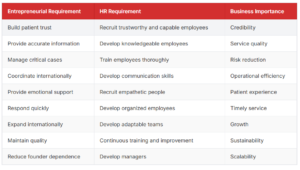
The IMIC case demonstrates that HR is deeply embedded in the entrepreneurial model.
Central Case Challenge
The central challenge for IMIC:
How can a specialized, trust-based healthcare assistance business scale its operations and expand into new markets while maintaining the employee capability, precision, empathy, and patient-centered service that have supported its development?
Discussion Questions
Entrepreneurship
- What problem did IMIC identify in the international healthcare market?
- How did the founder’s previous work experience contribute to the creation of IMIC?
- Why can professional networks be considered an entrepreneurial resource?
- How does IMIC differentiate its service from simply arranging hospital appointments?
- What role does trust play in IMIC’s business model?
- What opportunities and risks could arise from IMIC’s international expansion?
- Should IMIC continue diversifying into wellness, mental health, home nursing, and palliative care? What factors should be considered?
Human Resource Management
- What characteristics does IMIC look for when hiring fresh graduates?
- Why might six months to one year of training be appropriate for new employees in this industry?
- What type of training should employees receive before handling patients independently?
- How can IMIC maintain employee empathy and patience as it grows?
- What are the advantages and disadvantages of the founder remaining closely involved in operations?
- How can IMIC reduce dependence on the founder while maintaining service quality?
- What HR systems would IMIC need as it expands into more countries?
Strategic Management
- How can IMIC maintain trust while expanding its network of hospitals?
- How should IMIC balance patient preferences with professional assessment of suitable treatment options?
- What should IMIC consider when entering a new country?
- How can technology improve IMIC’s services without weakening the human element?
- What should be the organization’s priorities for sustainable growth?
Case Assignment
Assume that you have been appointed as an HR and Business Development Adviser to IMIC.
Prepare a three-year people and growth plan addressing:
- People
- Recruitment
- Employee competencies
- Training
- Career development
- Performance management
- Employee retention
- Leadership development
- Operations
- Patient coordination
- Emergency response
- International communication
- Quality control
- Knowledge management
- Growth
- International expansion
- New service areas
- Partnership development
- Customer trust
- Technology
- Risk
Identify five major risks that could affect IMIC’s growth and propose an HR or organizational response to each.
Key Case Lesson
The IMIC case demonstrates that entrepreneurship in a specialized service industry is not simply about identifying a market opportunity.
The entrepreneur must combine:
Industry knowledge + professional networks + customer understanding + trust + capable employees + continuous learning
The case also shows that in a high-stakes service business, people are part of the service itself. The employee who listens carefully, records information accurately, communicates with doctors, coordinates logistics, and supports a patient’s family can directly influence the customer’s experience.
As IMIC expands, its central management challenge is therefore not simply how to acquire more customers or enter more countries.
It is:
How to scale the organization’s people, systems, and capabilities without losing the trust and human connection at the heart of its service.